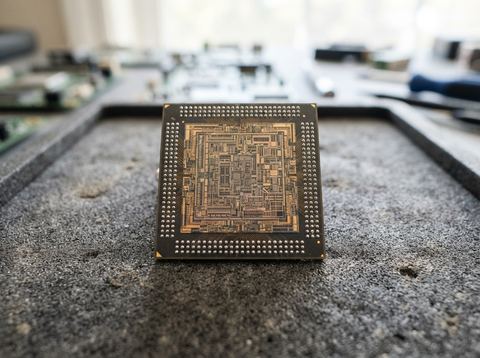


Broadcom has grown from a niche chip designer into a $1.8 trillion semiconductor and software giant, recording $63.9 billion in revenue in FY2025.
Broadcom Inc. sits at the intersection of two of the most consequential technology trends of our era: the surge in AI computing and the quiet dominance of enterprise software. From its headquarters in Palo Alto, California, the company has grown into one of the largest semiconductor businesses on the planet — and its financials make that claim hard to argue with.

A Company Shaped by Consolidation
Broadcom is, above all, a product of strategic mergers and acquisitions. That history shows up in the breadth of what it sells: cutting-edge chips on one side, enterprise infrastructure software on the other. The company went public on the NASDAQ under the ticker AVGO in August 2009 and has been assembling its empire methodically ever since.
What the Chips Actually Do
On the semiconductor side, Broadcom primarily designs rather than manufactures — the so-called fabless model — though it retains some production in-house. One standout example is its film bulk acoustic resonator (FBAR) filters, considered best-of-breed components that ship inside the Apple iPhone. Beyond that specific product, its semiconductors serve computing and networking broadly.
The AI Accelerator Opportunity
Custom AI accelerators have grown to account for the bulk of Broadcom's semiconductor business. As cloud companies and hyperscalers build out massive AI infrastructure, demand for purpose-built chips has surged. Broadcom designs these accelerators to customer specifications — a high-value, deeply embedded relationship with some of the world's largest technology spenders.
Software: A Substantial Second Business
Broadcom also sells virtualization, infrastructure, and security software to large enterprises, financial institutions, and governments. This is no sideline. It forms a substantial second business that rounds out the company's revenue base and delivers recurring income streams less sensitive to semiconductor-cycle swings.
Revenue Scale and Remarkable Growth
The numbers reflect a business operating at genuine scale. Broadcom recorded $63.9 billion in revenue in FY2025. More striking is the trajectory: revenue grew 133% from FY2021 to FY2025, a rate that outpaces most companies its size by a considerable margin.
Margins That Tell the Real Story
Broadcom is demonstrably profitable. Net income reached $5.9 billion in FY2025, translating to a net margin of 36.2% — meaning more than a third of every revenue dollar flows through to the bottom line. The gross margin of 67.8% reflects the pricing power that comes from selling differentiated, high-complexity products that customers cannot easily substitute.
How the Market Values Broadcom
Broadcom carries a market capitalization of $1.8 trillion, placing it among the most valuable companies in the United States. Shares trade on the NASDAQ at a recent price of $365.02 (15-minute delayed), and a price-to-earnings ratio of 76.5 signals that investors are pricing in substantial future earnings growth. The stock is currently trading 24% below its 52-week high, a reminder that even large, profitable companies experience meaningful volatility. Broadcom also pays a dividend yielding approximately 0.71% annually, offering a modest income component alongside the growth story.
Size, Staff, and Footprint
With roughly 33,000 employees and $171.1 billion in total assets, Broadcom operates at a scale few technology companies match. Its Palo Alto, California headquarters keeps it firmly rooted in Silicon Valley — fitting for a company whose fortunes are tied tightly to the semiconductor and enterprise software industries.
This article is factual reporting drawn from public filings and market data and does not constitute investment advice.