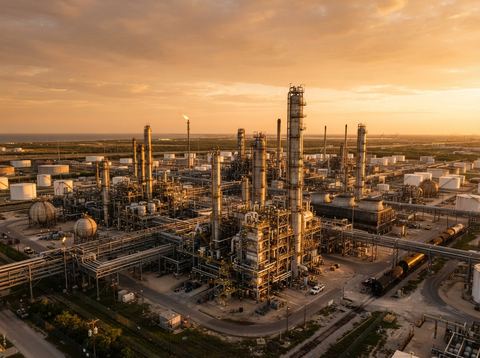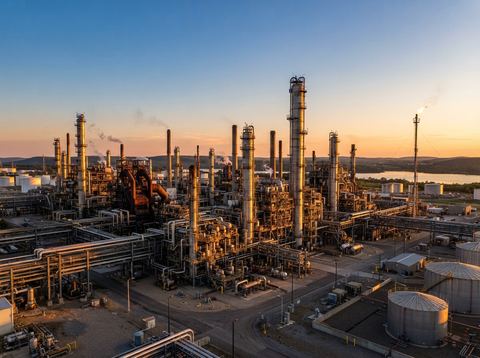

From a Texas headquarters, ExxonMobil runs one of the world's largest integrated oil and gas operations — here's what its financials reveal.
A Company Built for Scale
ExxonMobil has been part of American energy for well over a century. Founded in 1882 and publicly traded since March 1920, the company has grown into one of the most recognizable names in global industry — headquartered not in a downtown skyscraper but in Spring, Texas, where roughly 57,900 employees support an operation that touches nearly every stage of the oil and gas lifecycle.

What ExxonMobil Actually Does
The company is what the industry calls integrated: it doesn't just pump crude oil from the ground. ExxonMobil explores for, produces, refines, and sells petroleum products worldwide. It is also one of the world's largest manufacturers of both commodity and specialty chemicals — a business line that runs alongside, and often benefits from, its core energy operations.
Production at Daily Scale
The sheer volume of what ExxonMobil moves every day is worth pausing on. In 2025 the company produced 3.3 million barrels of liquids and 8.4 billion cubic feet of natural gas per day. Its total global refining capacity stands at 4.1 million barrels of oil per day — a figure that places it among the largest refiners anywhere on earth.
Reserves That Stretch Decades Forward
At the close of 2025, ExxonMobil held 19.3 billion barrels of oil equivalent in proved reserves. Of those, 69% were liquids. Reserves of that magnitude represent the long-term raw material for future production, giving the business a multi-decade runway that few industrial companies can match.
Reading the Revenue Figure
ExxonMobil posted $332.2 billion in revenue for FY2025. To put that in perspective: it is larger than the gross domestic product of most countries. That figure also represents a 16% increase from FY2021, signaling that growth — while measured rather than explosive — has been real and sustained across a four-year stretch that included significant global energy volatility.
Profitability in Plain Terms
Revenue tells you how much flows in; net income tells you how much stays. ExxonMobil kept $28.8 billion after all costs, taxes, and obligations in FY2025. That's the profit available to reinvest in operations, reduce debt, or return to shareholders. For a capital-intensive business where drilling, refining infrastructure, and logistics demand constant spending, sustaining that level of profitability is a meaningful signal of operational discipline.
The Balance Sheet's Weight
With $449.0 billion in total assets, ExxonMobil's balance sheet reflects the physical reality of the business: pipelines, refineries, drilling platforms, chemical plants, and proved reserves spread across the globe. Assets of that scale take decades to assemble and are not easily replicated.
How the Market Values It
Investors have assigned ExxonMobil a market capitalization of $621.4 billion, making it one of the most valuable publicly traded companies in the United States. Shares trade on the NYSE under the ticker XOM at a recent price of $136.54 (subject to a 15-minute delay), which is 20% below the stock's 52-week high — a reminder that even large, profitable companies see their share prices move with broader market and commodity cycles.
A Price-to-Earnings Snapshot
The stock carries a price-to-earnings ratio of 20.4, a standard valuation metric that compares the share price to the company's earnings per share. ExxonMobil also pays a dividend yielding approximately 3.02% annually, reflecting a long-standing practice of returning cash to shareholders.
More Than a Century in the Making
What stands out about ExxonMobil is not any single number but the combination: massive scale, consistent profitability, vast physical assets, and a production footprint measured in millions of barrels per day. Since its founding in 1882, the company has navigated oil booms, price collapses, and sweeping technological change — and today it remains a defining presence in global energy.
This article is factual reporting drawn from public filings and market data and is not investment advice.