
A plain-English look at ExxonMobil's FY2025 revenue, profit, and market value, and what the numbers say about the scale of its oil, gas, and chemical operations.
A Company Built on Scale
Exxon Mobil Corp is not a company that does one thing well in a small way — it does several enormous things at once. It explores for oil and gas, refines crude into fuel, and manufactures chemicals used across the economy, all under one corporate roof headquartered in Spring, Texas.
From 1882 to Today
The company's roots trace back to 1882, and it has been a publicly traded company since its IPO in March 1920. Few American businesses have operated continuously across so many decades, through booms, busts, and shifting energy markets, while remaining a fixture of the industrial economy.
What the Company Actually Produces
In 2025, ExxonMobil produced 3.3 million barrels of liquids and 8.4 billion cubic feet of natural gas per day. At year-end, its reserves stood at 19.3 billion barrels of oil equivalent, with 69% of that in liquids rather than gas.
A Major Refiner and Chemical Maker
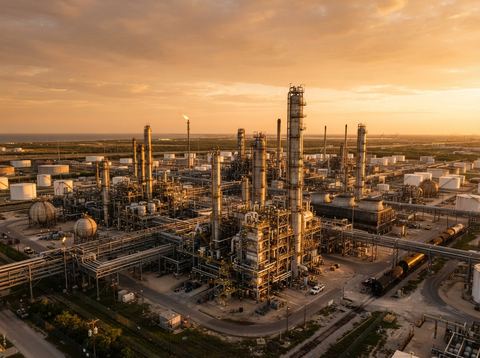
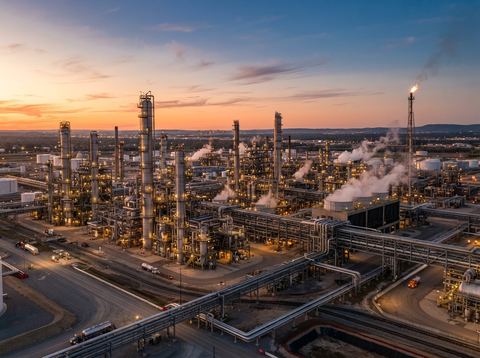
Beyond pulling oil and gas out of the ground, ExxonMobil is one of the world's largest refiners, with total global refining capacity of 4.1 million barrels of oil per day. It also ranks among the largest manufacturers of commodity and specialty chemicals, the building blocks used in everything from plastics to industrial materials.
Revenue and Profit in Plain Terms
For fiscal year 2025, ExxonMobil reported revenue of $332.2 billion and net income of $28.8 billion. Put simply, for every dollar of sales the company brought in, a meaningful slice made it through to the bottom line as profit — a sign of a business that, at its current scale, is generating real earnings rather than just moving large volumes of product.
Growth Over Four Years
Revenue climbed 16% between fiscal year 2021 and fiscal year 2025. That kind of multi-year growth, for a company already operating at hundreds of billions of dollars in annual sales, reflects both higher production and pricing dynamics across the energy sector during that stretch.
The Balance Sheet and Market Value
ExxonMobil's total assets stand at $449.0 billion, a figure that captures everything from oil fields and refineries to chemical plants and equipment spread across its global operations. The stock market, meanwhile, currently values the entire company at $621.4 billion in market capitalization, with shares recently trading around $138.88.
Reading the Valuation Signals
The stock trades at a price-to-earnings ratio of 20.7, a way of measuring how much investors are paying for each dollar of the company's profit. Shares are currently 19% below their 52-week high, and the company pays a dividend yielding about 2.97% annually — a regular cash payout to shareholders that is one of the ways a mature, profitable company like this returns money to its owners.
Employees and Footprint
Running an operation of this size takes people as well as pipelines and refineries. ExxonMobil employs approximately 57,900 people, a workforce spread across its exploration, production, refining, and chemical businesses worldwide, all coordinated from its headquarters in Spring, Texas.
The Bottom Line
Taken together, these figures describe a large, profitable, and long-established company: one with $332.2 billion in FY2025 revenue, $28.8 billion in net income, and a market valuation of $621.4 billion, trading publicly on the NYSE under the ticker XOM. This article is factual reporting drawn from public filings and market data, not investment advice.