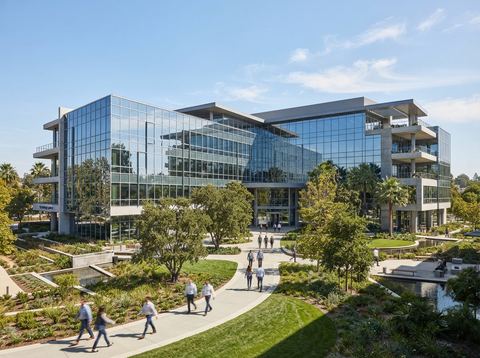


Meta Platforms connects close to 4 billion monthly users through Facebook, Instagram, WhatsApp, and Messenger, generating $201.0B in annual revenue with a $1.5T market cap.
A Network Without Rival
Meta Platforms, Inc. runs the most-used social media ecosystem on the planet. Founded in 2004 and headquartered in Menlo Park, California, the company has grown into a portfolio of platforms reaching close to 4 billion monthly active users worldwide — a scale that puts it in a category largely its own.

The Family of Apps
Meta's core business is its Family of Apps: Facebook, Instagram, Messenger, and WhatsApp. Together, these platforms serve users who want to stay in touch with friends, follow public figures, or run full-scale digital businesses, all at no charge to the end user.
That free-to-use model funds itself through advertising. Meta collects data generated across its application ecosystem and sells targeted ad placements to digital marketers — a deceptively simple engine that powers billions of dollars in annual revenue.
Revenue That Commands Attention
In FY2025, Meta reported revenue of $201.0 billion. Even more striking is the trajectory: revenue grew 72% between FY2022 and FY2025, an extraordinary expansion for a company already operating at this size.
Margins Built to Last
Profitability is where Meta's model truly stands apart. The company carries a gross margin of 82.0% and a net margin of 30.1% — meaning roughly thirty cents of every revenue dollar becomes net income. In FY2025, that translated to $60.5 billion in net income.
A $1.5 Trillion Market Cap
Meta trades on the NASDAQ under the ticker META. Its market capitalization stands at $1.5 trillion, and total assets reach $366.0 billion, reflecting years of heavy investment in global infrastructure.
A recent share price of $550.25 (15-minute delayed) shows the stock trading 30% below its 52-week high — a reminder that short-term market swings can diverge sharply from underlying business performance.
Reading the Valuation Metrics
Meta's price-to-earnings (P/E) ratio of 23.4 reflects how the market is currently pricing each dollar of earnings. The company also pays a dividend yielding about 0.38% annually, a modest payout that sits alongside continued heavy reinvestment in the business.
Reality Labs: The Long Game
Beyond its advertising core, Meta has been investing heavily in its Reality Labs division, focused on virtual and augmented reality hardware and software. Reality Labs remains a very small part of overall revenue today, but the company continues to channel significant resources into what it views as a long-term strategic opportunity.
Scale, Staff, and Staying Power
With approximately 78,865 employees, Meta is one of the larger employers in the American technology sector. The company went public in May 2012, and in the years since it has evolved from a single social network into a multi-platform advertising powerhouse operating at a genuinely global scale.
This article is factual reporting drawn from public filings and market data, and is not investment advice.