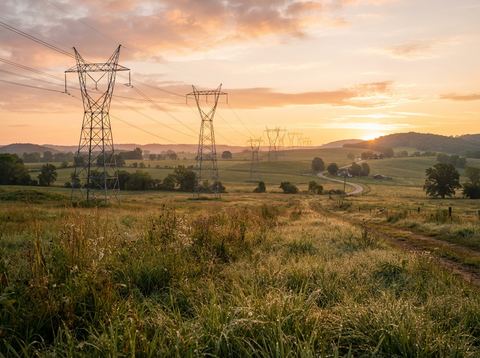


A look at eight directory-verified American utility companies and the essential infrastructure work they do, from power grids to midstream gas.
Power Nobody Notices Until It's Gone
Flip a switch, turn a thermostat dial, or run water through a tap, and there's a good chance one of the companies in this industry made it possible. Utilities are the quiet infrastructure of daily life — unglamorous until the moment they fail. The American Utilities sector, part of the broader Energy & Utilities world, exists to keep electricity, natural gas, and related infrastructure moving reliably to homes, farms, and factories.
What Counts As A Utility
The term covers more than the electric company that bills you monthly. It spans regulated power and gas providers, the midstream operators that gather and move fuel, and the infrastructure investors who own the pipes and wires underneath it all. Each plays a distinct role in a chain that starts at a wellhead or generating plant and ends at a customer's meter.
Regulated Power And Gas
Several companies in this directory operate as regulated utilities serving specific regions. Alliant Energy Corp, based in Madison, Wisconsin, and Ameren Corp, headquartered in St. Louis, Missouri, both serve customers across the American Midwest. Atmos Energy Corp, based in Dallas, Texas, focuses on natural gas distribution, while Black Hills Corp /SD/, out of Rapid City, South Dakota, brings utility service to communities across the northern Plains and Rocky Mountain region.
Midstream And Infrastructure Players
Not every company on this list bills a household directly. Antero Midstream Corp, based in Denver, Colorado, and Archrock, Inc., headquartered in Houston, Texas, work in the midstream segment — gathering, compressing, and moving natural gas rather than selling it at the meter. Brookfield Infrastructure Corp, based in New York, New York, takes a broader infrastructure-investment approach, holding stakes across utility-adjacent assets. AES Corp, headquartered in Arlington, Virginia, operates in the power generation space, another piece of the same puzzle.
Why Location Still Matters
Each of these companies is anchored to a specific American city or state, a detail that matters more than it might seem. Utilities are inherently local businesses — pipelines, substations, and distribution lines are fixed in the ground, tied to the regions they serve. Knowing whether a company is headquartered in Houston, Dallas, or Rapid City gives a sense of the regional footprint and regulatory environment it operates within.
Why Buyers And Investors Track This Sector
Utilities occupy a distinct place in the economy: demand for electricity and gas doesn't disappear in a downturn the way demand for discretionary goods might. That steadiness is part of why the sector draws sustained attention from investors and business buyers alike, who track these companies through public markets. All eight companies profiled here trade on major U.S. exchanges — the New York Stock Exchange or Nasdaq — under their respective ticker symbols, a baseline signal of scale and public accountability.
A Directory Built On Verification
This directory doesn't just list company names — it verifies them. For utilities specifically, that means confirming details like Made-in-USA origin where applicable, the presence of U.S.-based support and labor, and warranty terms, giving buyers a clearer picture before they engage with any provider.
The Bigger Picture
Together, these eight companies — spanning regulated power and gas, midstream gas infrastructure, generation, and broad infrastructure investment — illustrate just how many moving parts sit behind something as simple as a working light switch. From Arlington to Rapid City, Madison to Houston, American utilities form a decentralized but essential backbone, one regional operator at a time.