

A plain-English look at Union Pacific's $24.5 billion in revenue, steady profitability, and market standing, drawn entirely from public filings and market data.
A Railroad Built on Scale
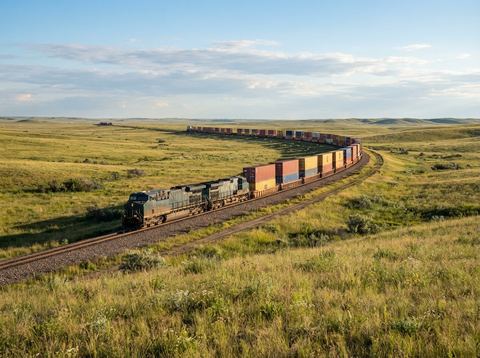
Few American companies operate at the physical scale of Union Pacific. Headquartered in Omaha, Nebraska, and founded in 1969, the company runs more than 30,000 miles of track across the western two-thirds of the United States, making it the largest public railroad in North America.
What Moves on the Tracks
Union Pacific doesn't sell a single product — it moves other people's goods. Coal, industrial products, intermodal containers, agricultural goods, chemicals, fertilizers, and automotive shipments all travel its network, connecting factories, farms, and ports across the western U.S.
Cross-Border Reach
A notable piece of the business sits south of the border. Union Pacific owns about one-fourth of the Mexican railroad Ferromex, and freight moving to and from Mexico has historically made up roughly 10% of its revenue — a reminder that American rail logistics are tightly woven into North American trade.
Revenue at $24.5 Billion
In fiscal 2025, Union Pacific generated $24.5 billion in revenue. That figure represents money collected from freight customers across every commodity the railroad hauls, from grain cars to shipping containers.
Growth Over Four Years
Revenue grew 12% from fiscal 2021 to fiscal 2025. That's a modest but steady climb for a company already operating at massive scale, suggesting demand for rail freight has held up over that stretch rather than shrinking.
Profitability: The Bottom Line
Union Pacific reported net income of $7.1 billion in fiscal 2025. Set against $24.5 billion in revenue, that means the company kept a substantial share of every dollar it billed customers after covering its costs — a sign of a profitable, well-run operation rather than one scraping by on thin margins.
Assets on the Books
The company's total assets stand at $69.7 billion. For a railroad, that figure largely reflects the enormous physical footprint required to run the business — track, locomotives, rail cars, and terminals spread across thousands of miles.
How the Market Values It
Investors currently assign Union Pacific a market capitalization of $161.7 billion, with shares recently trading at $283.12 (15-minute delayed). The stock is trading near its 52-week high, meaning it's changing hands close to the top of the range it has occupied over the past year.
Reading the P/E Ratio
Union Pacific carries a price-to-earnings ratio of 23.6. In plain terms, that's the multiple the market is currently placing on the company's per-share earnings — a figure that reflects investor sentiment at this moment rather than any guarantee about future performance.
A Dividend Payer
The company also pays a dividend, yielding about 1.95% annually. That means shareholders who hold the stock receive a regular cash payment on top of any change in share price, a common feature among large, established industrial companies.
Workforce Behind the Network
Running a network of this size takes people as well as track. Union Pacific employs approximately 28,647 workers, a workforce responsible for keeping trains moving, terminals staffed, and freight flowing across the western United States.
A Long-Standing Public Company
Union Pacific has traded publicly since its June 1969 IPO under the ticker NYSE: UNP, in the Logistics & Shipping industry, making it one of the longer-tenured names on American stock exchanges.
The Bottom Line
This snapshot is factual reporting drawn from public filings and market data, not investment advice.